The network is part of the AI computer
Optical networking and rack-scale systems receive attention for a reason. Multi-GPU performance depends on how data moves between the machines.
A systems problem becomes visible
NVIDIA's March 2026 partnership with Coherent focused on optical technology for larger data-centre architectures. Its later Rubin production announcement includes optical Ethernet networking within the wider platform. These developments put connectivity alongside compute in the infrastructure discussion. NVIDIA and Coherent: optical networking partnership ↗ NVIDIA: Vera Rubin enters full production ↗
For a buyer, the implication is not that every deployment needs the newest optical fabric. It is that a collection of powerful servers does not automatically behave like one well-connected system. The application determines how much communication is required and where delays will matter.
Different links have different jobs
Communication within a GPU server and communication between servers are separate parts of the topology. So are the paths to storage and the ordinary management network. A fast link in one part of that arrangement cannot remove a bottleneck elsewhere.
Start by mapping the data flow. Does each server work on independent requests? Does a model span several devices or nodes? Must checkpoints or datasets move frequently? Those questions help establish whether networking is central to the workload or primarily a supporting requirement.
Independent inference replicas may scale differently from a tightly coupled training job. Buying an elaborate fabric for the former without evidence can waste budget; underspecifying the latter can leave expensive accelerators waiting.
A port is not a complete connection
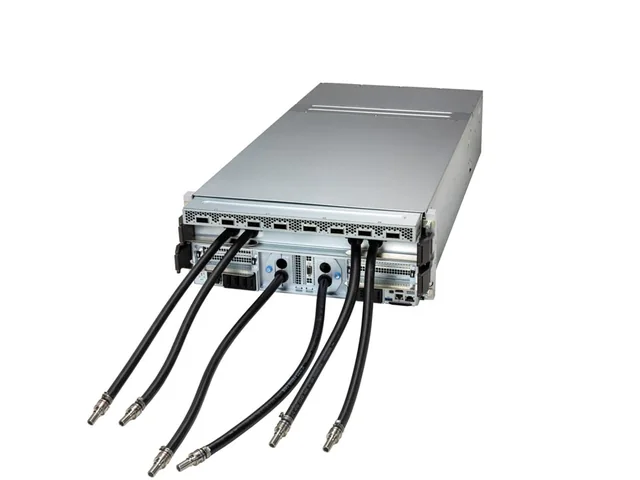
A network bill of materials includes adapters, switches, optics or cables, appropriate physical lengths and the support needed to operate them. Compatibility and topology matter alongside the headline speed.
Check the proposed configuration as a whole. Identify which components are included in a server quote and which belong to the wider cluster purchase. Establish who is responsible for configuration and fault diagnosis when the problem crosses a server and a switch.
Also consider observability. A throughput result can conceal retransmissions, congestion or uneven performance that appears only under a mixed workload. The operations team needs a way to identify those conditions after installation.
Test the application across the planned topology
A single-server benchmark cannot establish multi-server scaling. Measure the intended workload at the relevant node counts and record the communication settings. Compare completed work with the cost and power of the full configuration.
Optical integration is an important direction for large infrastructure, but it does not erase the need for topology planning. For many buyers, the immediate improvement is more ordinary: a complete network specification, suitable cables and a validation plan that includes every link the application depends on.
Sources & further reading
Primary sources for the reported developments and technical context. Analysis and conclusions are our own; linked specifications and documentation can change.
- NVIDIA and Coherent: optical networking partnership ↗Published 2 March 2026
- NVIDIA: Vera Rubin enters full production ↗Published 31 May 2026
Sources checked 29 September 2026.