Liquid cooling changes the installation project, not just the server
Integrated racks can simplify delivery. The facility connections, service responsibilities and acceptance checks still need to be specified.
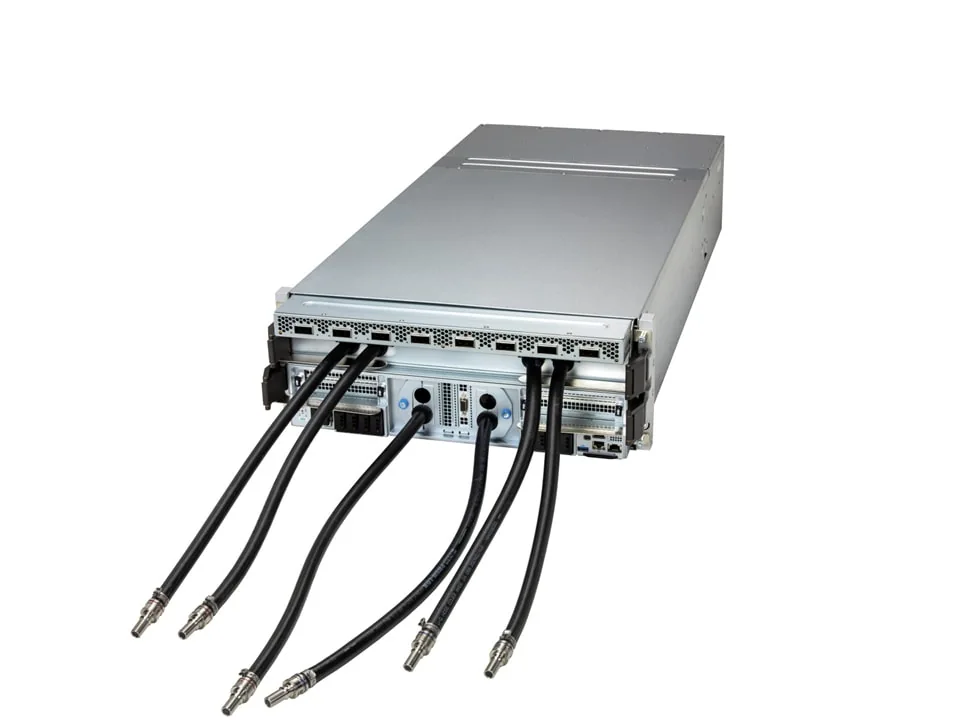
More of the system arrives together
Supermicro's July 2026 AI rack announcement emphasises integrated rack offerings, including liquid-cooling components. Its May announcement with Verda describes a European deployment using liquid-cooled AI infrastructure. These are examples of manufacturers selling a larger portion of the installed system as a coordinated package. Supermicro: integrated AI rack portfolio ↗ Supermicro and Verda: European AI infrastructure deployment ↗
That can reduce the number of interfaces a buyer has to assemble independently. It does not mean the receiving site has no work to do. Heat still needs to leave the building's computing environment, and the facility must be ready to accept the specific system.
Draw the boundary of responsibility
The first useful document is a diagram showing where the supplied cooling system ends and the facility system begins. Identify the relevant distribution equipment, connections, monitoring and service access. Use the manufacturer's requirements for the exact configuration rather than a generic assumption about liquid-cooled racks.
Electrical supply, rack weight, delivery access and maintenance space remain part of the installation. Cooling is one dependency among several. A project can meet the thermal requirement and still encounter a problem with lifting, access or power distribution.
Plan for service before installation
Ask how routine maintenance and component replacement are performed. Establish which party responds to a fault, what parts are covered and which procedures require trained service personnel. Record the intended monitoring and escalation process.
This is a commercial specification as much as a technical one. A hardware price is easier to compare when the installation and support boundaries are explicit. Otherwise, one offer may include work that another assumes the customer's facility team will provide.
Acceptance should cover the installed system under an agreed load, not merely confirmation that the rack arrived. The supplier and facility operator should agree the evidence required to show the deployment meets the relevant operating conditions.
Choose cooling for the actual environment
Air cooling can remain appropriate where the selected system and facility support it. Liquid cooling can enable other configurations and densities, but it introduces different installation and service requirements. Neither description is enough to decide the purchase by itself.
Our recommendation is to compare complete deployment proposals. Include the equipment, site work, installation schedule and support model. Avoid assuming that an efficiency claim translates directly into a particular bill reduction at your location.
The attraction of an integrated rack is a more coordinated project. The buyer's job is to make sure that coordination extends across the final metre between the delivered equipment and the facility that must run it.
Sources & further reading
Primary sources for the reported developments and technical context. Analysis and conclusions are our own; linked specifications and documentation can change.
- Supermicro: integrated AI rack portfolio ↗Published 30 July 2026
- Supermicro and Verda: European AI infrastructure deployment ↗Published 27 May 2026
Sources checked 29 September 2026.