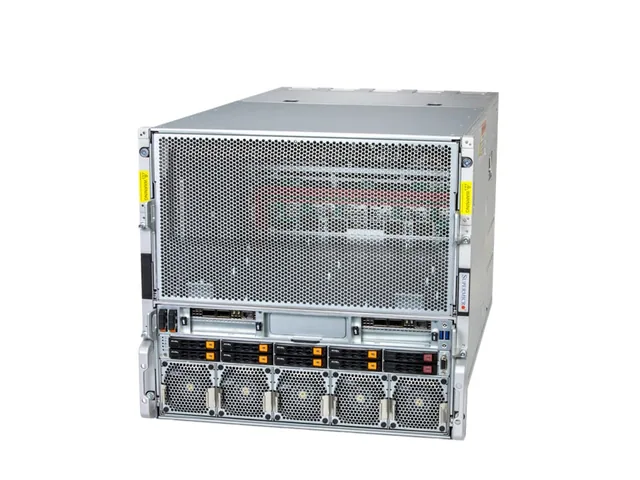
AMD's Helios challenge is about the entire deployment
A major Anthropic commitment puts AMD's rack-scale approach in focus. Software readiness will matter as much as the accelerator specification.
A commitment with a timetable
AMD and Anthropic announced a partnership on 22 July 2026 covering up to two gigawatts of MI450-series GPU deployments in Helios systems. The first gigawatt is scheduled to begin deployment in the first half of 2027. The stated configuration combines MI455X accelerators with EPYC processors, Pensando networking and ROCm software. AMD and Anthropic: planned MI450 and Helios deployment ↗
The scale makes this a significant platform commitment. The timetable makes it a future deployment programme, rather than evidence of that entire capacity being operational now. Both points belong in the same reading of the announcement. Large commitments can demonstrate confidence while still leaving considerable integration and execution work ahead.
Competing at system level
AMD's September platform update presents Helios as part of a broader computing strategy extending from large data centres to local AI. For the server market, the relevant point is that an alternative platform must compete as an operating environment, not simply as a silicon specification. AMD: Advancing AI 2026 platform update ↗
A purchasing comparison therefore needs more than memory capacity and nominal compute performance. It should include the network topology, management tools, supported inference engines, observability and the path for driver and firmware updates. These are the details that determine whether a promising benchmark becomes a service the operations team can maintain.
Software compatibility needs a workload
ROCm's documentation provides supported deployment paths for vLLM and identifies hardware and software prerequisites. That is useful evidence of an available software route. It is not a guarantee that every model, extension or custom kernel in an existing environment will work unchanged. AMD ROCm documentation: vLLM compatibility and deployment ↗
An evaluation should use the team's actual model revisions and inference settings. Include startup time, memory consumption, error handling and long-running stability alongside throughput. Check the less glamorous dependencies too: monitoring agents, container images, backup procedures and the tools used when a job fails at night.
What a credible alternative looks like
A second platform becomes commercially useful when a team knows what it can run, what it costs to operate and what support it can obtain. That does not require migrating every workload. A well-defined inference service or batch-processing queue may be a better first deployment than an immediate replacement of the entire estate.
The counterweight is engineering effort. Supporting two platforms can consume time that a small team would otherwise spend on its product. The decision should therefore turn on measurable benefits for a chosen workload, with an explicit budget for validation and ongoing maintenance.
Helios strengthens the argument for evaluating AMD as a systems supplier. The practical question for an individual buyer is narrower: which configuration, with which software, can meet the next operational requirement at a compelling total cost?
Sources & further reading
Primary sources for the reported developments and technical context. Analysis and conclusions are our own; linked specifications and documentation can change.
- AMD and Anthropic: planned MI450 and Helios deployment ↗Published 22 July 2026
- AMD: Advancing AI 2026 platform update ↗Published 16 September 2026
- AMD ROCm documentation: vLLM compatibility and deployment ↗
Sources checked 29 September 2026.